
Progress Beats Perfection Every Time
Write a Crappy First Draft

🍳 Monday Morning, Knife’s Edge
It started, as most Mondays do, with lunch boxes.
Three kids, three different ideas about what lunch should be. I’m at the counter assembling it all — the sandwiches, the snacks, the careful negotiations — while simultaneously redirecting my son away from the waffles. His stomach’s been off the last couple of days, which is absolutely not a mystery when you consider that my wife made her banana bread this weekend. Household favorite. No one has any self-control around it, including me. Add a short visit from Tia Mia, my wife’s sister, in from Hawaii, down from DC, before jetting home to Honolulu early Sunday morning, take all the energy that comes with that, and you’ve got a Monday morning that is one small thing away from coming completely off the rails.
It didn’t. Nicole and I stuck the landing. Lunches packed, kids fed, backpacks on, out the door and off to school
Then the house went quiet.
This is the part of the morning I protect. Post-breakfast, pre-work: meditate, prayers, review the day’s plan. The twenty minutes that set the tone for everything that follows. I sat down and started moving through it — and somewhere in there, this entire post dropped into my head. Fully formed.
I grabbed my phone and hit record.
My plan for the morning did not include stopping to dictate an essay. It never does. And that’s the point I want to make — because here’s what I’ve noticed about interruptions, including the ones that come from inside your own head:
When life breaks the plan, we get self-critical. I lost focus. I got distracted. I’m already behind.
Sometimes, we get frustrated at the people around us for the chaos we attribute to them.
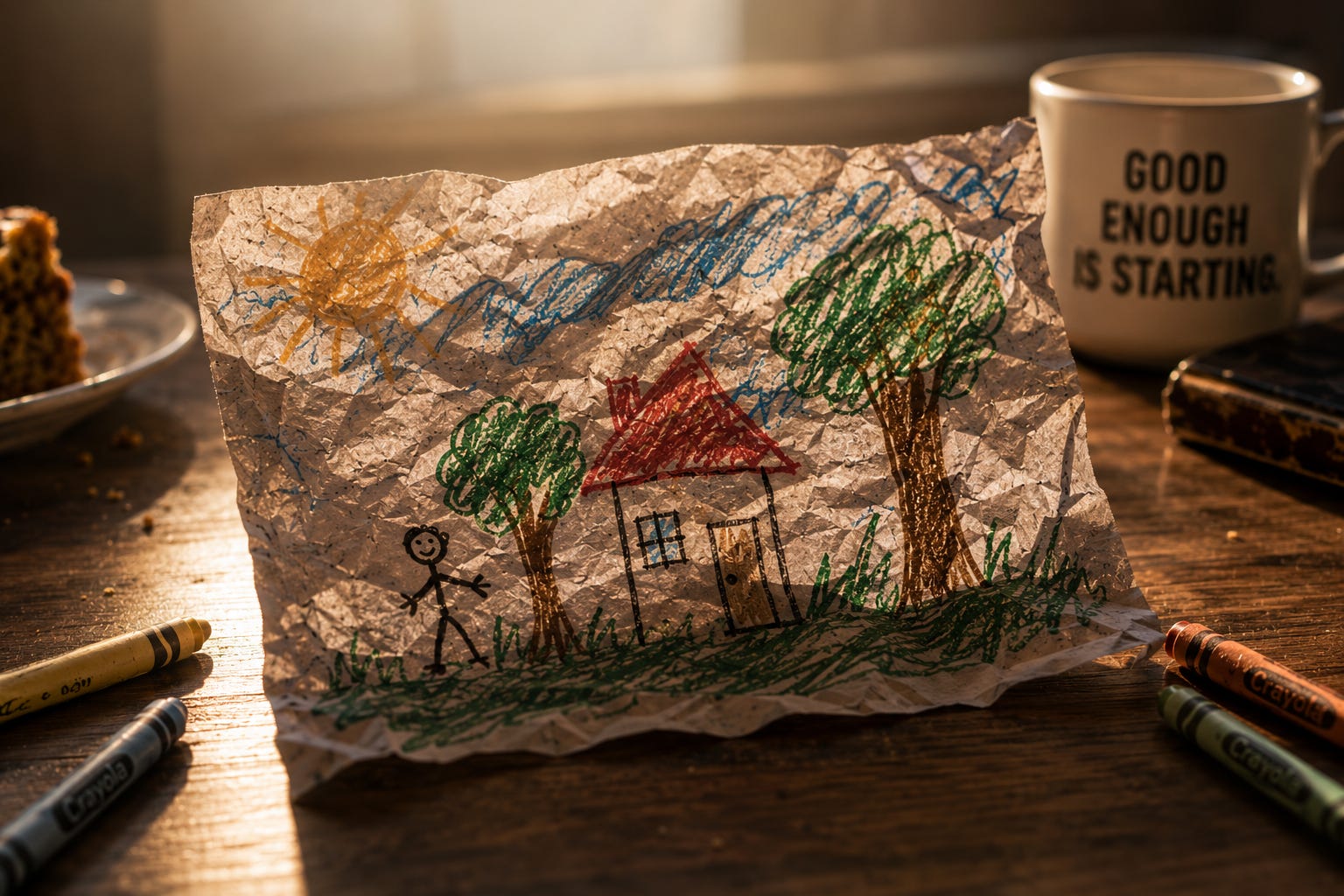
And then — like my daughter when she crumples her drawing before she’s even finished it because she made one mark that wasn’t quite right — we’re ready to start over from scratch. To throw out everything that came before the mistake.
When she does that I always tell her the same thing: the mistake becomes part of the finished painting.
Same with writing. Same with Mondays.
Because here’s the lesson I keep coming back to — one I learned the hard way, across more false starts than I care to count:
Give yourself permission to write a crappy first draft.
Which is another way of saying: give yourself permission to make mistakes and keep moving. The day isn’t lost because the morning was messy. The work isn’t ruined because you got interrupted. The story you should be telling yourself isn’t I fell behind — it’s watch what I still manage to pull off.
At the end of the day, the things you actually got done are there. Might not be pretty. Might need work. But they exist, which means you can fix them.
Not bad for a Monday.
📃The Blank Page Problem
Here’s what I’ve learned from writing seven books, two years of blog posts, and more television pitches than I can count:
The thing that stops most people isn’t a lack of talent. It’s not a bad plan. It’s not even bad luck.
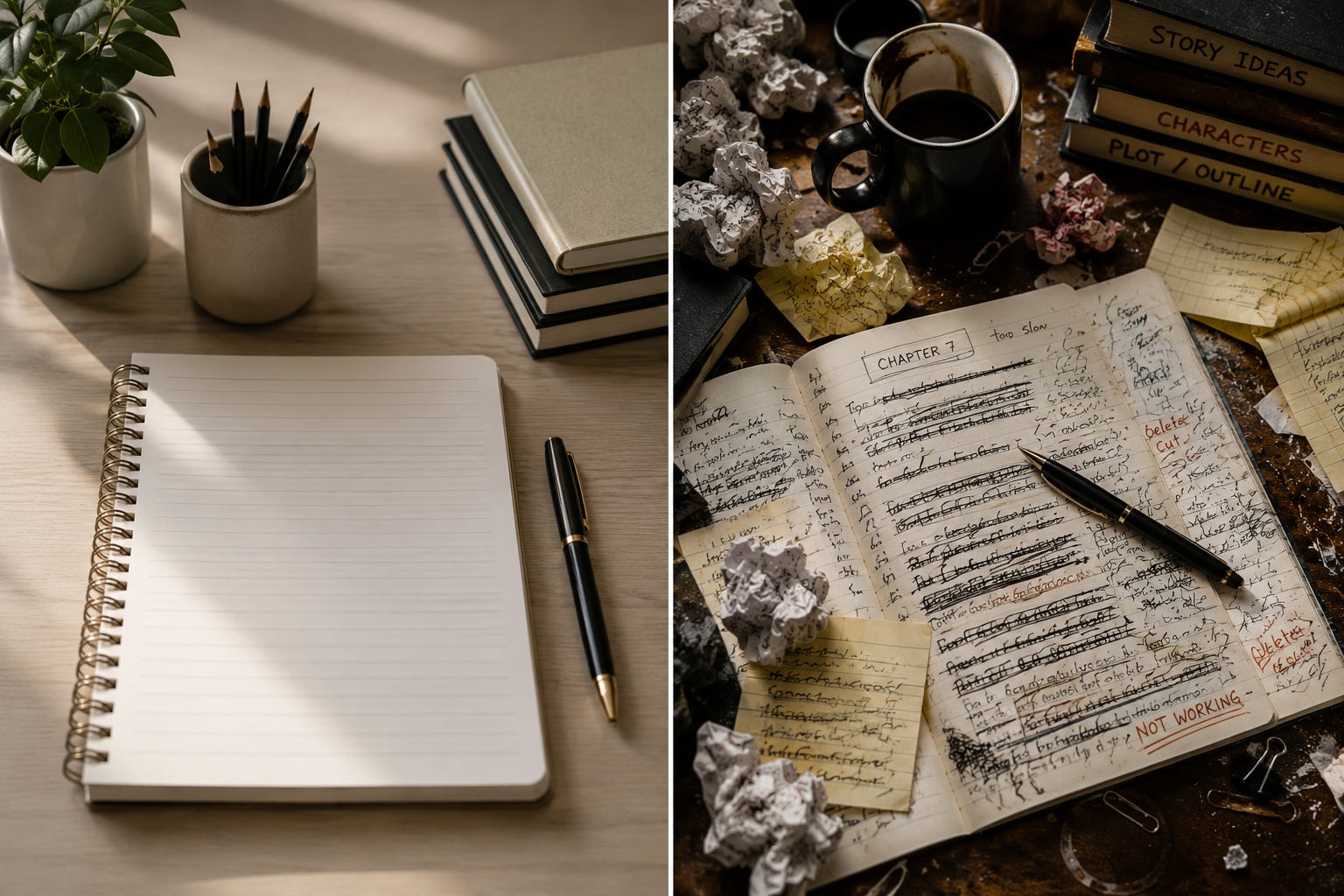
It’s the blank page.
The blank page is the career you haven’t started. The business you keep researching but never launch. The conversation you rehearse in the shower but never have. The book, the move, the leap — the thing you know you’re supposed to do but keep waiting to feel ready for.
You’re not waiting to feel ready. You’re waiting to feel certain. And certainty never comes.
The answer to the blank page — the one that actually works — isn’t better planning or more preparation. It’s a crappy first draft.
Not a good one. Not even a decent one. A crappy one.
The kind you’d be embarrassed to show anyone. The kind where half the sentences don’t work and the structure is a mess and you’re not even sure you’re telling the right story.
The point isn’t to get it right. The point is to get it moving.
Sixty Thousand Words of Perfect Garbage
After I published my first novel, I wanted to write a series. So I started writing.
And writing. And tinkering. And rewriting.
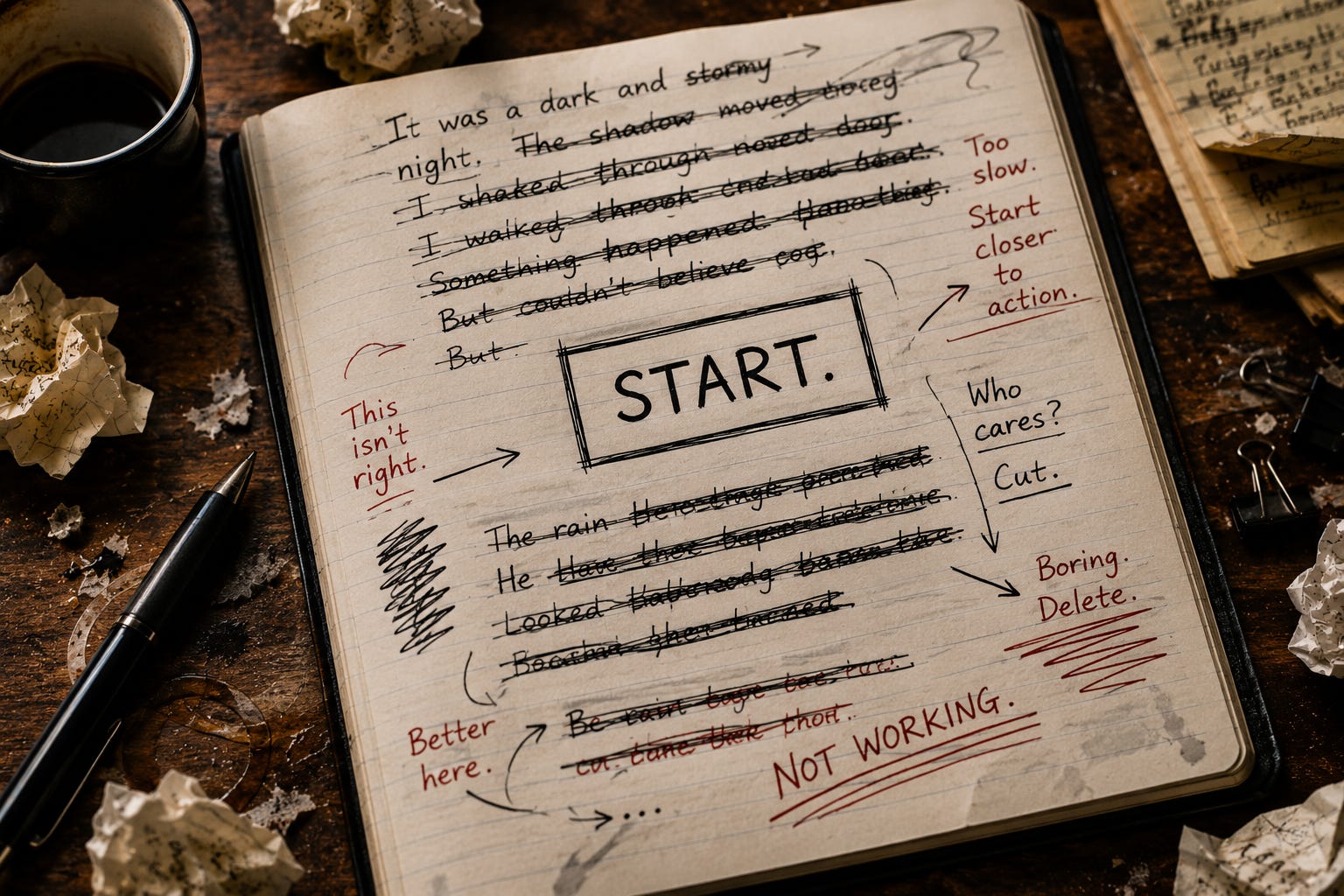
I started three different novels. I wrote 60,000 words of one. 36,000 words of another. I spent months on each, trying to get them right. Perfecting scenes. Polishing dialogue. Reworking chapters until they gleamed.
Then I realized: the stories didn’t work.
Not the sentences. Not the scenes. The stories. The fundamental ideas underneath all that polished writing were flawed. And I’d spent so much time tinkering with each one that I never stepped back far enough to see that the thing I was perfecting was broken.
I polished broken things until they shone.
If I had given myself permission to write those drafts fast and messy — to get the story down without worrying about whether every sentence sang — I would have seen the problems in weeks, not months. I would have moved on sooner.
So when I sat down to write The Double — the first Eddie Ankin book — I did something different. I gave myself permission to write a crappy first draft.
I overwrote it badly. It was too long. The pacing sagged. Whole chapters needed to go. But I got to the end. I had a draft that existed. Which meant I could see the whole story for the first time. Which meant I could fix it.
Which I did.
A crappy first draft that exists is infinitely better than a perfect plan that doesn’t.
This Isn’t the First Time I’ve Needed This Permission
A few weeks ago I wrote about learning to dictate — how it took me over a year of failed attempts before it finally clicked. If that post resonated with you, it’s because the same principle is at work here.
The moment I stopped trying to narrate a finished book and started just talking — letting the ums stay, letting the sentences come out ugly — everything broke open. Not because I found a better technique. Because I gave myself permission to be bad at the beginning.
Same lesson. Different wall. If you haven’t read it here → Be a Professional
The Voice That Tells You to Wait
I know what stops you. I know because it stopped me.
Who are you to do this? This isn’t who you are. You’re too old. You’re too young. You’re not smart enough. You’re too late. You don’t belong here.
That voice sounds like wisdom. It feels like self-awareness.
It’s not wisdom. It’s fear.
And the crappy first draft is how you beat it.
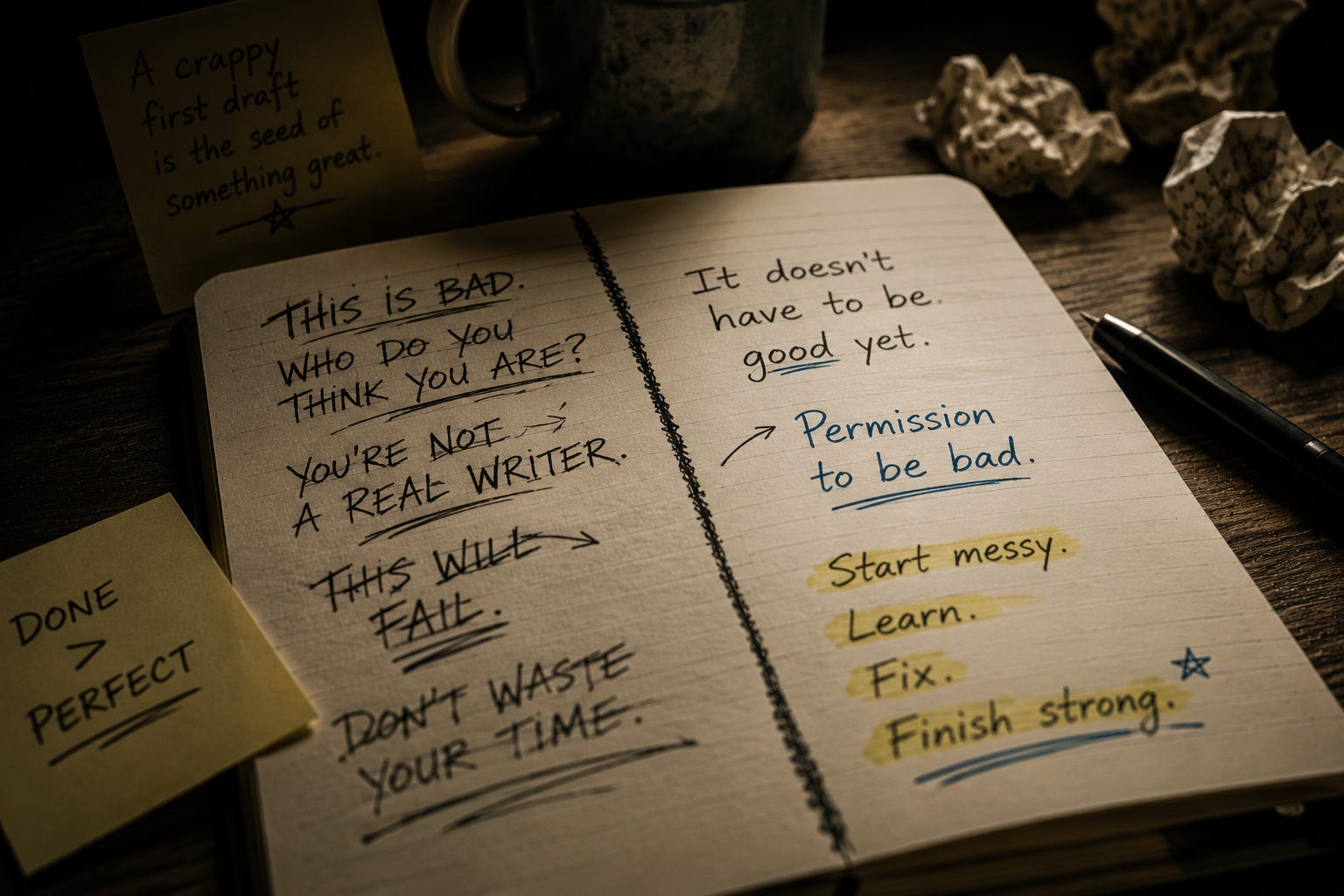
You don’t beat fear by thinking harder. You don’t beat it by planning more. You don’t beat it by reading another book about beating it. You beat it by moving — by doing the thing badly, on purpose, with full knowledge that the first version is going to be wrong.
You cannot revise a blank page. You can fix bad writing. You can restructure a messy draft. You can cut what doesn’t work and sharpen what does. But you cannot do any of that to nothing.
And you cannot redirect a life that isn’t in motion.

✅ Three Things You Can Do Today
1. Name the blank page.
What’s the thing you’ve been planning, researching, or thinking about but haven’t started? The career move. The hard conversation. The project. Write it down. Not the plan — just the thing. Give it a name. That’s the first sentence of your crappy first draft.
2. Do the worst possible version of it. Today.
Send the email you’ve been rewriting in your head for two weeks. Make the call you’re not ready for. Apply for the thing you’re not qualified for. Write the first page knowing it’s going to be bad. You can fix it tomorrow — but only if it exists.
3. Separate the draft from the finished product.
The reason you’re stuck is that you’re trying to write the final version on the first pass. Nobody does that. The first draft is just you telling yourself the story. The second draft is where you make it good. The third is where you make it yours. Give yourself permission to be bad at the beginning. That’s not failure. That’s the process.
This idea came to me this morning, somewhere between the lunch boxes and the quiet that followed. I wasn’t looking for it. I was trying to slow down, to be present, to let the morning settle.
The moment I let go of the plan, the story showed up.
That’s how it works. Not when you’re ready. Not when the outline is finished. Not when the conditions are perfect.
It shows up when you start moving.
So write the next scene. Even if it’s bad. Even if it’s the wrong one. Even if you throw it out and start over tomorrow.
A crappy first draft that exists is infinitely better than a perfect plan that doesn’t.
Start.
If this hit home, share it with someone staring at their own blank page.
Further Reading
On Writing by Stephen King — half memoir, half masterclass on the craft
Turning Pro by Steven Pressfield — on Resistance and what stands between you and your work
If you’re getting value from these posts, consider becoming a paying subscriber. Your support helps me bring you the best — straight to your inbox. Because every good story deserves a great ending.